
The first web page went live on August 6, 1991. It was created by Tim Berners-Lee to share information about the World Wide Web project which was intended as a communication tool for government agencies and universities. It ran on a NeXT computer at the European Organization for Nuclear Research, CERN. By 1993, another 129 websites had gone live.
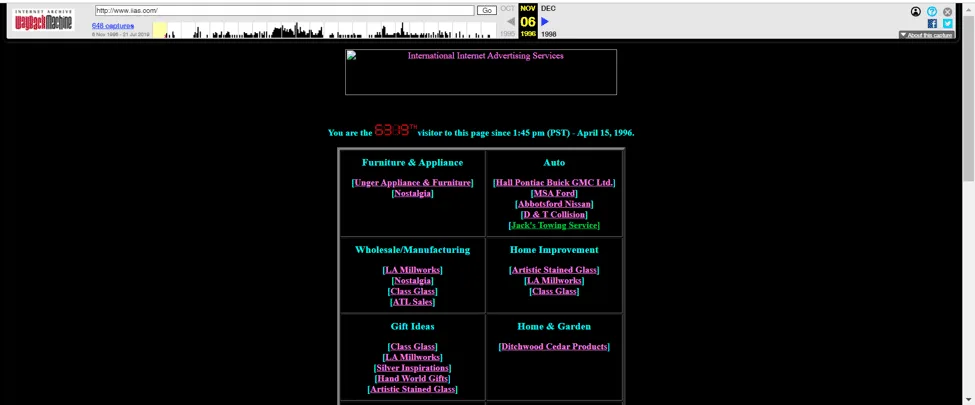
In 1995, Mike graduated with honours in Computer Information Systems and Micro Computers in Business. Now, there were 23,500 sites on the World Wide Web. Mike was about to add to that number, although it wouldn’t be easy. Still, the man had a dream. He set up a business and named it International Internet Advertising Services Inc.
Mike and Angela were now married and had a baby boy who kept Angela very busy at home. Mike was kept busy figuring out how to create websites and building a web server to host them. While he was clearly a computer wiz, knowledge about this World Wide Web was hard to find.
How to put this into practice
At 25, Mike was a husband, father, and ambitious entrepreneur. He persevered. Accessing the WWW through a BBS (short for Bulletin Board System), he put up his first website and somehow managed to convince a few other businesses to use this new form of advertising.
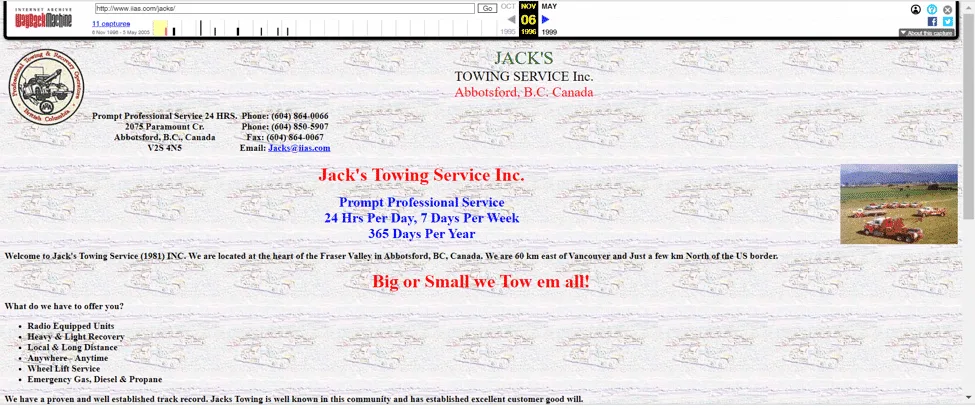
Mike’s site was basically a directory of his client’s websites since Larry Page and Sergey Brin hadn’t yet invented Google. Jack’s Towing was one of Mike’s first clients.
“I remember Jack,” says Mike. “I called him up a few months after I’d created his web page to ask if it had brought him more business. He said no, and I was crushed. I started to apologize. Jack stopped me and laughed as he told me I’d saved him millions of dollars. I didn’t understand. Jack explained that while he was still getting the same number of calls from clients, he was getting tons of calls from suppliers vying for his business. He was able to make some great deals and that made his business far more profitable. He was a very happy client.”
Results you can expect
Digital cameras were yet to become popular, so most clients provided printed snapshots. That meant scanning the images, which was quite time-consuming. James was 16 and going to school, but also had a side job digitizing the history of rural BC communities. His job was to scan books and create a website. James and Uncle Mike forged their first professional arrangement: James scanned the images for Mike’s sites and Mike helped James install hardware and get websites running.
Still working for the Correctional Service, Joanne was transferred to Abbotsford in 1995 and became the Regional Manager for Policy, Planning, and Information Technology for BC and the Yukon. She remembers being annoyed walking through the office seeing people playing Solitaire, which was released with Windows 3.0. Still, she defended this to her superiors as a way for staff to get used to using a mouse.
Forty-five kilometers away in Surrey, Andrew was spending a lot of his time designing computers and network systems and teaching others how to use them. Paul was still living with his parents in Romford, going to college and working part-time in a tropical fish shop. Nick had just been born in Ontario.
Continued:
The Story of Us 1980s
The Story of Us 1991-1995
The Story of Us 1996-1999
The Story of Us 2000
The Story of Us Early 2000s
The Story of Us - More on the Early 2000s
The story of Us - mid-2000s
The Story of Us - The Interlude
The Story of Us - 2007-2015
The Story of Us - The last five years
The Story of Us - 2045
Key takeaways
Use these checkpoints to turn The Story of Us - 1991 to 1995 into action:
- Clarity beats decoration, visitors should know what to do in seconds.
- Mobile speed and readable copy usually move the needle faster than visual novelty.
- Pair strong design with a clear offer and follow-up path.
Talk with IIAS
If you want help applying these ideas across your website, SEO, or ads, request a free growth review. We will tell you what is working, what is holding you back, and the best next move for your Fraser Valley business.
 Blog
Elevate Your SEO: Advanced Link Building Tactics
Elevate Your SEO: Advanced Link Building Tactics Link building is the #1 activity in off-page SEO and is the bulk of most SEO campaigns. As a cornerstone of modern SEO strategies, link building not only enhances website visibility but also serves as a key driver for business growth and online authority. This article d…
Read article → Blog
Voice Search Optimization: Capturing the Voice-First Audience
Voice Search Optimization: Capturing the Voice-First Audience Voice search optimization is rapidly becoming a cornerstone for business success. This transformation, driven by the increasing use of voice-activated devices, demands a new approach to SEO, one that is attuned to the nuances of spoken language and the dis…
Read article → Blog
Effective Advertising - Part 2: Visibility
We’re exploring the five key factors in effective advertising. First up is visibility. What we’re talking about here is getting the ads in front of your target audience. So, the first thing to think about is who are you targeting and where do you find them? Remember to consider market segments, and this is where […]
Read article →