
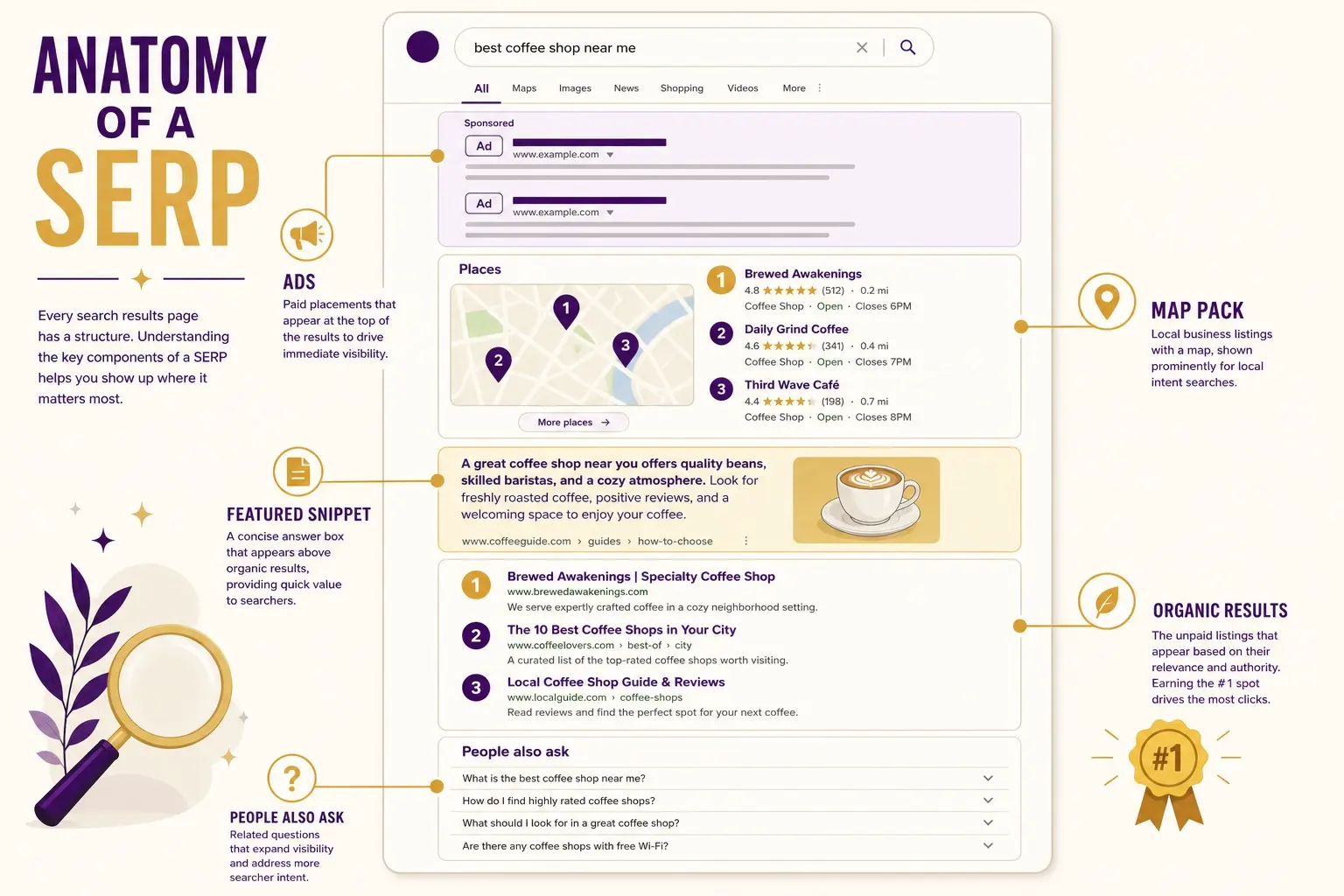
Search engine results pages (SERPs) are what Google shows after someone types a query. They are not a tidy list of ten blue links. A typical page mixes paid ads, a local map pack, organic results, and extra blocks such as shopping, images, videos, People Also Ask, and, on many queries, an AI overview.
Each block matches a different kind of search intent. If you ignore the layout and only chase “average position,” you will fight for a slot that does not exist on that query. Website search optimisation starts by looking at the live SERP, then deciding whether the job is a service page, a Google Business Profile, a paid ad, or all three. That is the same process behind basic SEO and a full search engine optimization program. More guides live in SEO Education.
What a search engine results page is made of
Most local and commercial searches include two or more of these sections.
Paid or sponsored results
These are ads. Someone bid on the query. They sit above, beside, or below the organic list, and sometimes on the map. Paid placement is search engine marketing, not organic SEO. Both can appear on the same page, which is why we look at them together.
Organic results
These are the unpaid listings Google chose as relevant. Title, URL, and description (plus sitelinks on some brand queries) are what you earn with on-page work, content, links, and a site Google can crawl. This is the main target of on-page SEO and off-page SEO.
Local map pack
For “near me” and city-plus-service searches, Google often shows a map and three businesses before the organic list. Distance, relevance, and prominence (including reviews and a complete Google Business Profile) decide who appears. Ranking #8 in organic while missing the map pack can still mean you lose the call.
Featured snippets and People Also Ask
A featured snippet pulls a short answer above the first organic result. People Also Ask expands related questions. Clear headings and direct answers on a page make those blocks possible. They are not a separate product you buy.
Shopping, images, and video
Product queries often show Shopping ads and carousels. Some queries lead with images or YouTube. If the SERP is a gallery, a text-only service page will struggle no matter how good the copy is.
AI overviews
On many informational and some local queries, Google now shows an AI-generated summary above the classic results. The summary cites sources. You cannot “pay for a slot” in it. You can make the business easy to cite: accurate pages, a complete profile, and mentions on sites Google already trusts. Nobody can promise a specific AI answer.
Above the fold still matters
On a phone, the first screen might be an ad, a map, or an AI box. “Position 1” organic can sit below all of that. Click-through depends on the whole layout, not only the organic rank. That is why we screenshot the SERP for the money keywords, on mobile, in the city the customer actually searches from.
Search intention decides the mix. “Emergency plumber Abbotsford” wants a phone number on the map. “What is crawl budget” wants an explanation, which is why a guide like crawl budget belongs in organic, not in ads.
How businesses use SERPs
You take advantage of a results page by matching the format Google is already showing.
- If the query is local, treat the Google Business Profile as a ranking surface, not a listing you set and forget.
- If ads fill the top, budget for them or pick a more specific phrase where organic is still visible.
- If competitors win with service-area pages, one homepage will not cover the same intent.
- If the snippet is a table or a list, put that structure on your page.
Technical SEO still sits underneath: a page that is not indexed cannot appear in any of these blocks. Engagement metrics then tell you whether the people who clicked found what they wanted or bounced back to the SERP.
How IIAS reads a SERP on a real campaign
Before we write a page we search the phrase on a phone, in the right city, and note every block above the organic list. Then we check Search Console for queries that already get impressions. Then we decide the asset: profile work, a new service page, a refresh, or Google Ads. Tools such as search engine optimization tools help quantify competitors. The SERP decides the strategy.
If you want that read on your own keywords, request a free growth review. We will show you what Google is actually showing in your market, and which block is worth winning first.